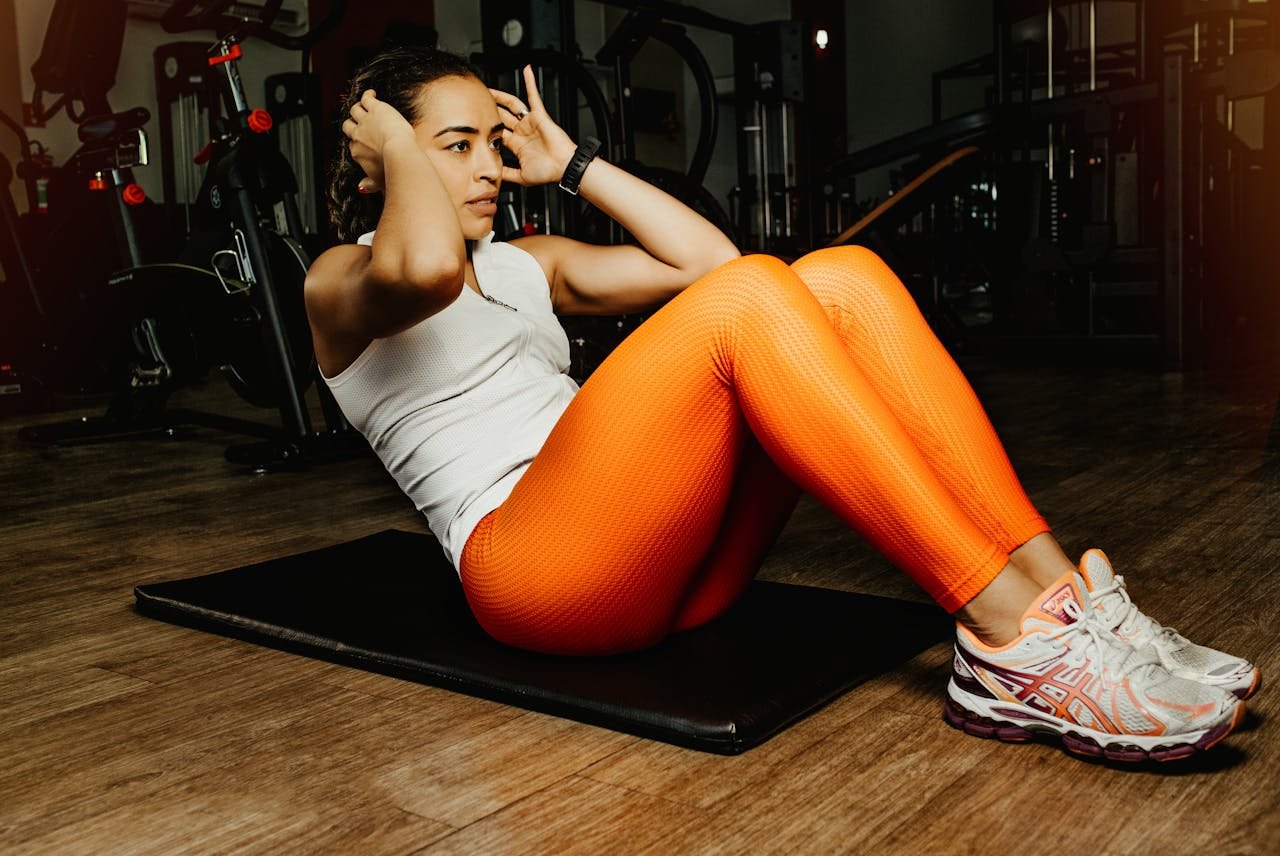
The Short Answer on Whether You Can Spot-Reduce Fat From Your Stomach or Glutes, Before We Get Into the Evidence
No, not in any way that will change how you look. You cannot pick a body part, train it hard, and cause the fat sitting on top of it to disappear faster than fat elsewhere. Crunches will not flatten your stomach. Glute bridges will not strip fat off your glutes. Six decades of research has tested this, mostly by torturing volunteers with sit-ups and one-legged leg presses, and the pattern is consistent.
That is the honest headline. But if we stopped there, we would be doing what most articles on this topic do, which is repeat “spot reduction is a myth” as a slogan and skip the parts that are genuinely unresolved.
Because the literature is not quite as tidy as the slogan suggests. There is a measurable physiological effect where fat next to a working muscle does break down slightly faster. There is at least one randomized trial from the past few years whose authors argue spot reduction does exist. And there is a much more useful truth hiding underneath the whole debate, which is that the shape of your stomach and glutes is not determined by fat alone.
So let’s go through it properly.
Worth saying at the outset: this is an article about physiology and evidence, not about whether your stomach or glutes need changing. Where your body stores fat is largely outside your control, and a body that stores it somewhere you would rather it did not is not a defective body.
Why the Physiology of Fat Mobilization Makes Targeted Fat Loss From One Body Part Structurally Unlikely
To use stored fat for energy, your body has to break triglycerides in the fat cell down into free fatty acids and glycerol, then move them into the bloodstream to be burned somewhere else, usually in muscle. That process, lipolysis, is driven mostly by hormones: adrenaline, noradrenaline, and the absence of insulin.
Hormones travel in blood. Blood goes everywhere. When you do a set of crunches, the adrenaline released does not check which muscle is working and then knock politely on the door of the nearest fat cell. It circulates. Fat is mobilized systemically, from the whole body, in proportions dictated largely by how sensitive each fat depot is to those signals.
This is why the muscle you train and the fat that leaves are two separate accounts. Training your abs makes your abs stronger and larger. It does not create a local withdrawal from the fat sitting over them, any more than chewing gum slims your face.
There is also a simple arithmetic problem. A set of crunches burns a trivial number of calories. Even if every one of those calories came from abdominal fat specifically, which it does not, the effect on how you look would be undetectable.
What the Controlled Spot Reduction Studies Actually Found When They Tested Sit-Ups, One-Arm Training and One-Leg Training
The clever thing about spot reduction research is the study design. If you train one limb and leave the other alone, that person becomes their own control. Same diet, same hormones, same everything, except one leg or arm did all the work. If localized fat loss were real, it would show up there.
| Study | What it tested | What it found |
|---|---|---|
| Katch and colleagues, 1984 | A sit-up training program, with fat cell samples taken from abdomen, buttock and upper back | Fat cell size shrank, but no more at the abdomen than at the other two sites |
| Kostek and colleagues, 2007 | 104 people trained one arm only for 12 weeks, measured by MRI | Fat loss was generalized across the body rather than concentrated in the trained arm |
| Vispute and colleagues, 2011 | Six weeks of abdominal exercise, five days a week, diet held constant | No reduction in abdominal subcutaneous fat, waist circumference or body fat |
| Ramírez-Campillo and colleagues, 2013 | High-repetition single-leg press training, other leg untrained | The trained leg lost no more fat than the untrained one. Significant fat loss appeared in the upper body |
That last result is the one people find hardest to believe. Participants trained one leg exhaustively, and the fat came off their arms and torso. It is a strange finding, and it is exactly what you would predict if fat mobilization is systemic rather than local.
A 2022 systematic review and meta-analysis pooled thirteen studies covering more than a thousand participants who trained one limb against the other. The pooled effect size for localized fat loss in the trained limb came out at roughly zero. Not small. Not borderline. Zero.
Pooled effect of training one limb on fat loss in that limb
Pooled effect size approximately −0.03, meaning no detectable localized advantage.
Source: Ramírez-Campillo et al., systematic review with meta-analysis, Human Movement, 2022.
The Counter-Evidence Nobody Mentions: Spot Lipolysis, and the Randomized Trial That Argues Spot Reduction Is Real
Here is where the honest version of this article diverges from the standard one.
In 2007, a Danish group led by Bente Stallknecht measured blood flow and lipolysis directly in the subcutaneous fat next to a working muscle, using one-legged knee extensions. Fat next to the contracting muscle showed higher blood flow and higher lipolysis than fat next to the resting one. The mechanism is not imaginary. Localized fat breakdown does happen.
The catch is magnitude. The amount of fat mobilized this way is tiny relative to what the whole body is doing during the same session, and mobilizing a fatty acid is not the same as removing it permanently. Fatty acids that are not oxidized get taken back up and re-esterified. A measurable blip in a laboratory does not translate into a visibly flatter stomach.
Then there is a more provocative study. A randomized controlled trial published in recent years, and worth reading in full, compared two exercise groups matched for energy expenditure. One did treadmill running only. The other combined running with torso rotation and abdominal crunch work, four days a week for ten weeks. Total fat loss and body weight change were broadly similar between groups. But trunk fat mass dropped roughly 700 grams more in the abdominal training group, and did not change meaningfully in the running-only group. The authors’ conclusion was blunt: spot reduction exists in adult males.
Ten weeks, energy expenditure matched between groups
Total fat mass lost
Trunk fat mass lost
Source: Brobakken et al., randomized controlled trial. Sixteen overweight males, aged around 43. A single small study in one narrow population.
So does that settle it in favor of spot reduction? No, and here is why you should be cautious about it.
Sixteen participants. All male. All overweight, average age forty-three. The abdominal group trained for nearly an hour, four times a week, on top of running. And even if you take the result entirely at face value, the “spot reduction” benefit was around 700 grams of trunk fat across ten weeks. That is roughly a pound and a half. It is real, if it replicates, and it is nowhere near what anyone means when they buy an ab machine hoping to see their abs.
The intellectually honest position, and the one a good coach should hold, is this: a small localized effect may exist under specific, high-volume training conditions, the effect is far too small to be a strategy, and the overwhelming weight of the evidence still says you cannot choose where fat comes off. Anyone claiming this trial vindicates crunches for belly fat has read the abstract and not the sample size.
Why Your Body Loses Fat From Some Places First: Genetics, Sex Hormones, and Regional Adipose Tissue Differences
If you cannot choose the order, what does choose it?
Fat is not one tissue. Different depots behave differently. Abdominal fat, particularly visceral fat around the organs, tends to be relatively easy to mobilize and responds well to an energy deficit. Gluteofemoral fat, the fat on the hips, glutes and thighs, tends to be more stubborn. It has a different balance of adrenergic receptors, and it appears to be more readily stored and more reluctantly released.
That pattern is not a design flaw. Lower-body fat is generally associated with a more favorable metabolic risk profile than abdominal fat. Your body appears to hold onto it for reasons that have nothing to do with what you want to see in the mirror.
Layered on top of that: sex, genetics and age. Estrogen influences the tendency toward gluteofemoral storage; androgens push toward abdominal storage. Distribution shifts across the menopause transition. And a substantial slice of individual variation is simply inherited, which is why two people on the same deficit lose fat from completely different places in a completely different order.
The practical consequence is the sentence nobody wants to hear: the last place you lose fat from is usually the place you most want to lose it, and there is no exercise that reorders that queue. There is only getting leaner overall, and being patient enough for the queue to reach the front.
What Actually Changes the Shape of Your Stomach and Glutes, Since It Is Not Only About Fat
This is the part that gets buried under the myth-busting, and it is the part that matters if your actual goal is a change in shape rather than a change in a number.
Body shape is fat plus muscle plus skeletal structure. You cannot change the third. You can change the first two, and they behave very differently.
| What you want to change | What actually does it |
|---|---|
| Less fat over your stomach | A sustained energy deficit. Where it comes off first is not yours to choose |
| More visible abdominal definition | Lower overall body fat, plus direct abdominal training to build the muscle underneath |
| Rounder, fuller glutes | Progressive resistance training with enough load, volume and protein. This is muscle, not fat, and it genuinely is local |
| A smaller waist measurement | Fat loss. Not waist trainers, not corsets, and not ab machines |
| Less bloating around the middle | Often a digestion, fiber or hydration issue rather than a fat issue at all |
Read the third row again, because it is the loophole people are actually looking for and did not realize they had.
You cannot target fat. You can target muscle. Muscle hypertrophy is genuinely local: train your glutes hard and progressively, and your glutes grow. That changes your shape. It changes it more, for most people, than the last two pounds of fat ever would. The same applies to the abdominal wall, which is why some people look more defined at a given body fat level than others.
So the answer to “can I spot-reduce my glutes” is no. But the answer to “can I change how my glutes look” is emphatically yes, just through the opposite mechanism from the one you were asking about. Our overview of how a structured transformation plan is built covers how fat loss phases and muscle-building phases are meant to fit together, and the programs page outlines the glute-focused approach in more detail.
What Liposuction, Cryolipolysis and Other Body Contouring Procedures Do and Do Not Actually Achieve
There is a category of intervention that genuinely does remove fat from one place: surgery and energy-based body contouring devices. It is worth being clear about what they are and are not.
Liposuction physically removes subcutaneous fat cells from a treated area. Cryolipolysis and similar cleared devices damage fat cells in a treated area so the body clears them over subsequent weeks. Both reduce localized subcutaneous fat pockets. Neither is a weight loss treatment, and providers who are honest about it say so.
The things people are rarely told:
- These procedures act on subcutaneous fat, not visceral fat. They do not address the fat depot most associated with metabolic risk.
- Removing fat cells from one region does not stop you gaining fat. If energy balance goes positive again, the remaining cells elsewhere expand, and the distribution can end up looking different from before.
- They are medical procedures with real risks, including nerve injury, burns, contour irregularities and, in the case of cryolipolysis, a rare complication where the treated fat grows rather than shrinks.
- Marketing claims made for these devices and for the clinics selling them sit under federal advertising law. The Federal Trade Commission’s Health Products Compliance Guidance requires competent and reliable scientific evidence behind health-related claims, and states plainly that before-and-after testimonials do not substitute for it.
If you are considering any of this, that is a conversation with a board-certified physician who examines you in person, not with a coach and not with an article. We can tell you what the exercise science says. We cannot tell you whether a surgical procedure is appropriate for your body, and anyone in the fitness industry who offers an opinion on that is speaking well outside their lane.
The Marketing Claims Around Targeted Belly Fat Loss That Should Immediately Make You Suspicious
| The claim | What is actually going on |
|---|---|
| Waist trainers “melt” belly fat | They compress tissue while worn. Nothing is melted. Prolonged tight compression can restrict breathing and digestion |
| Sweat belts and sauna suits burn stomach fat | You lose water, which returns as soon as you drink. Sweat is not fat leaving the building |
| Fat-burning creams and “cellulite” gels | Any visible change is usually temporary skin tightening or dehydration of the surface tissue |
| Supplements that “target stubborn belly fat” | A health claim requiring competent scientific substantiation. Ask for the randomized trial. There usually isn’t one |
| Ab machines and vibration belts | May contract the muscle. Electrical stimulation studies have specifically failed to show regional fat reduction |
A useful filter: if a product promises to change fat in one specific location without changing your energy balance, it is claiming to have solved a physiological problem that the entire research literature has failed to solve. The prior probability is not favorable.
The 2026 Population Context, and Why Targeted Fat Loss Is Such a Persistent Marketing Angle
The reason this myth has survived sixty years of contradictory evidence is that it is extremely profitable, and the market for it is enormous.
National Center for Health Statistics figures published in February 2026, drawn from NHANES measurements taken August 2021 through August 2023, put the age-adjusted prevalence of obesity among US adults age 20 and older at 40.3%, with 9.7% classified as severe obesity, and a further 31.7% overweight. Separately, NCHS data published in April 2026 found that 47.2% of adults met the federal aerobic activity guideline in 2024.
US adults age 20 and older, measured height and weight
Source: NCHS Health E-Stat No. 111, published February 2026, based on NHANES August 2021–August 2023.
Tens of millions of people would like a specific part of their body to look different, and a solution that requires only a gadget and no change to how they eat is a far easier sell than the one that requires an energy deficit sustained across months. That is the whole business model. Understanding why the claim is false is, in a practical sense, one of the more valuable things you can learn about fitness, because it saves you from most of the industry at once.
Frequently Asked Questions About Spot Reduction, Stubborn Belly Fat and Targeted Glute Fat Loss
So are ab exercises pointless?
Not at all. They build the muscle that becomes visible when body fat drops, and a strong trunk transfers to almost everything else you do. They are just not a fat loss tool.
Why does my stomach look flatter some mornings than others?
That is almost always digestion, water and food volume rather than fat. Fat does not appear and disappear overnight.
Is “stubborn” fat a real thing or just an excuse?
It appears to be real at the level of tissue biology. Some depots release fat more reluctantly than others. It does not mean the fat is impossible to lose, only that it tends to go last.
Will more cardio strip fat off my stomach faster?
Cardio increases energy expenditure, which helps you lose fat overall. It does not tell your body where to take it from.
Can I grow my glutes and lose belly fat at the same time?
Sometimes, particularly if you are newer to resistance training or returning after a layoff. For most trained people it is more efficient to prioritize one at a time, which is a programming question rather than a physiology one.
How long until the last stubborn area finally changes?
Longer than you want. It typically shifts only in the later stages of a fat loss phase, which is precisely why people quit before they see it and conclude that spot reduction must be necessary.
When Concern About One Body Part Stops Being a Fitness Question
It is worth speaking to a physician or a mental health professional if:
- Distress about a specific body part is occupying a large share of your daily thoughts
- You check, measure or photograph one area repeatedly and it does not reduce the anxiety
- You are restricting food heavily, or exercising through injury or exhaustion, to change one region
- You are considering a cosmetic procedure primarily because you feel you have run out of options
- Rapid abdominal enlargement is happening without a change in your diet or training, which can have medical causes and should be examined
Persistent, distressing preoccupation with a perceived flaw in appearance is a recognized clinical condition, and it is not something training harder resolves. A coach can build you a program. A coach cannot diagnose or treat body dysmorphic disorder, disordered eating, or any medical cause of abdominal change, and should not attempt to. Personal training is not a licensed profession in the United States, and knowing where that line sits is one of the more meaningful things to ask about before hiring anyone, alongside the practical questions covered in our breakdown of what a 3-month body transformation costs.
Editorial Standards and How This Article Was Researched
This page was written and edited by the team at Body Transformation Online, drawing on practical coaching experience and on the primary research literature.
Every study referenced links to its primary source, indexed on PubMed or PubMed Central, and every population figure links to the National Center for Health Statistics report it came from. Where the evidence conflicts, we have shown both sides and explained why we weigh them the way we do, rather than presenting a contested question as settled. Where a study is small or narrow, we have said so.
This article has not been reviewed by a physician and makes no claim of medical review. It is general education about exercise physiology, not medical advice, and it is not a substitute for individualized assessment by a licensed healthcare professional. If you are considering a cosmetic or surgical procedure, or you have a medical concern about changes in your body, speak to a qualified physician.
Last reviewed and updated: July 2026. Further guides are available on our blog.
References and Citations
- Katch, F.I., Clarkson, P.M., Kroll, W., McBride, T., & Wilcox, A. (1984). Effects of sit up exercise training on adipose cell size and adiposity. Research Quarterly for Exercise and Sport, 55(3), 242–247.
- Kostek, M.A., Pescatello, L.S., Seip, R.L., et al. (2007). Subcutaneous fat alterations resulting from an upper-body resistance training program. Medicine & Science in Sports & Exercise, 39(7), 1177–1185. Available at: https://pubmed.ncbi.nlm.nih.gov/17596788/
- Vispute, S.S., Smith, J.D., LeCheminant, J.D., & Hurley, K.S. (2011). The effect of abdominal exercise on abdominal fat. Journal of Strength and Conditioning Research, 25(9), 2559–2564. Available at: https://pubmed.ncbi.nlm.nih.gov/21804427/
- Ramírez-Campillo, R., Andrade, D.C., Campos-Jara, C., et al. (2013). Regional fat changes induced by localized muscle endurance resistance training. Journal of Strength and Conditioning Research, 27(8), 2219–2224.
- Ramírez-Campillo, R., et al. (2022). A proposed model to test the hypothesis of exercise-induced localized fat reduction (spot reduction), including a systematic review with meta-analysis. Human Movement. Available at: https://hummov.awf.wroc.pl/A-proposed-model-to-test-the-hypothesis-of-exercise-induced-localized-fat-reduction,143162,0,2.html
- Stallknecht, B., Dela, F., & Helge, J.W. (2007). Are blood flow and lipolysis in subcutaneous adipose tissue influenced by contractions in adjacent muscles in humans? American Journal of Physiology: Endocrinology and Metabolism, 292(2), E394–E399. Available at: https://pubmed.ncbi.nlm.nih.gov/16985258/
- Brobakken, M.F., et al. Abdominal aerobic endurance exercise reveals spot reduction exists: a randomized controlled trial. Available at: https://www.ncbi.nlm.nih.gov/pmc/articles/PMC10680576/
- Scotto di Palumbo, A., et al. (2021). Effect of an endurance and strength mixed circuit training on regional fat thickness: the quest for the “spot reduction”. International Journal of Environmental Research and Public Health, 18(7), 3845. Available at: https://pmc.ncbi.nlm.nih.gov/articles/PMC8038840/
- Fryar, C.D., Afful, J., & Saif, N.T. (2026). Prevalence of Overweight, Obesity, and Severe Obesity Among Adults Age 20 and Older: United States, 1960–1962 Through August 2021–August 2023. NCHS Health E-Stat No. 111. National Center for Health Statistics. Available at: https://www.cdc.gov/nchs/data/hestat/hestat111.htm
- Elgaddal, N., Kramarow, E.A., Weeks, J.D., & Reuben, C. (2026). Aerobic Physical Activity Among Adults Age 18 and Older: United States, 2024. NCHS Data Brief No. 555. National Center for Health Statistics. Available at: https://www.cdc.gov/nchs/products/databriefs/db555.htm
- Centers for Disease Control and Prevention. Physical Activity Basics: Benefits of Physical Activity. Available at: https://www.cdc.gov/physical-activity-basics/benefits/index.html
- Federal Trade Commission. (2022). Health Products Compliance Guidance. Available at: https://www.ftc.gov/business-guidance/resources/health-products-compliance-guidance